


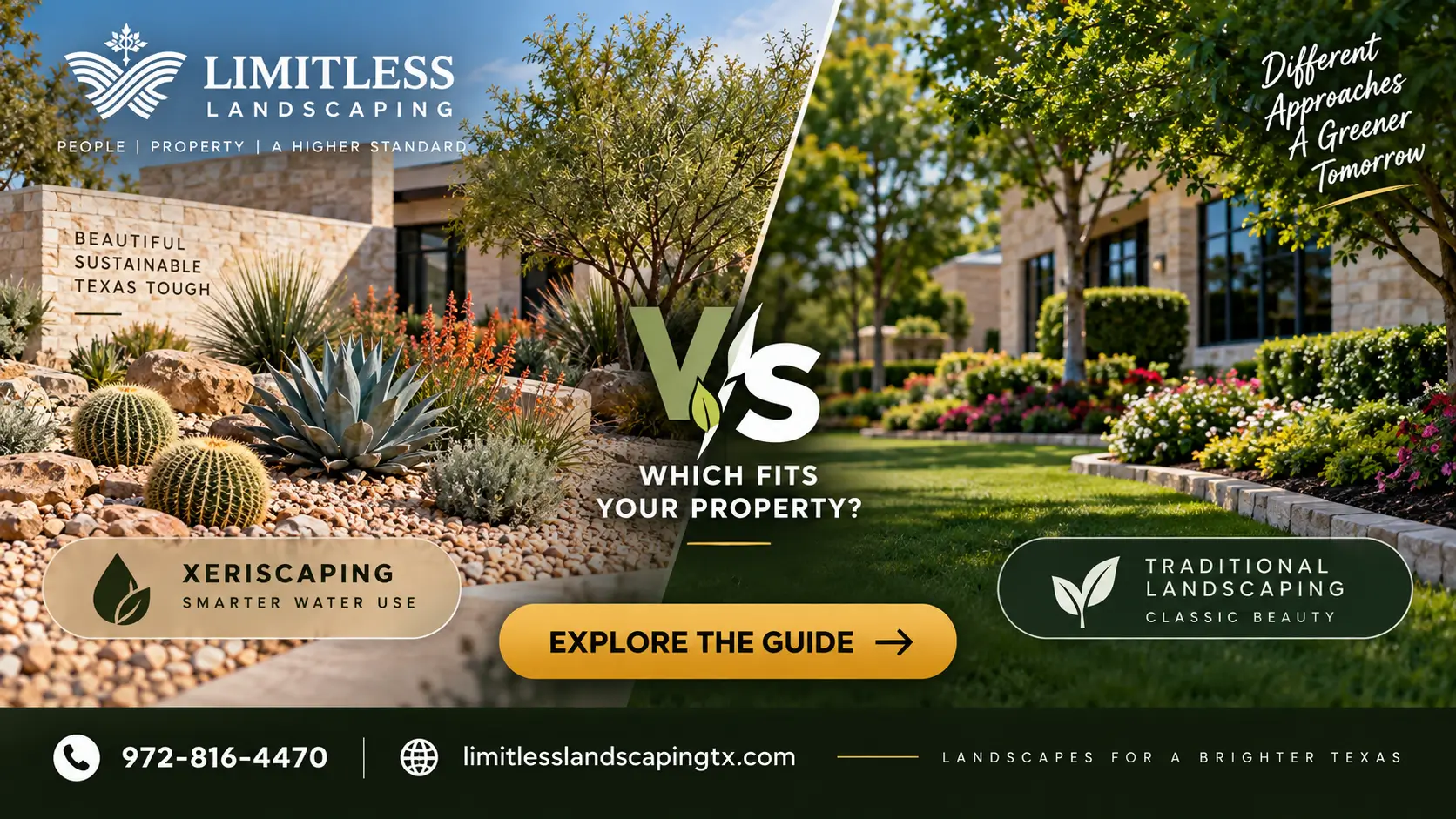
Choosing between xeriscaping vs traditional landscaping in Texas is not always a choice between rocks and a green lawn. Both approaches can create an attractive property when they are designed around the site, the homeowner's goals, and North Texas conditions.
For homeowners in Southlake, Colleyville, Westlake, Grapevine, Trophy Club, and surrounding DFW communities, the bigger question is how much water, maintenance, turf, plant material, and outdoor function you want from your yard.
Limitless Landscaping helps homeowners create landscapes that balance curb appeal with practical performance. In many cases, the best solution is not completely traditional or completely xeric. It is a thoughtful combination of both.
If you are asking what xeriscaping landscaping is, the simplest answer is that it is an approach designed to use water more efficiently.
A xeriscape typically combines appropriate plants, thoughtful irrigation, improved soil, mulch, practical turf placement, and landscape planning based on the site's natural conditions.
It does not mean covering the entire yard in gravel.
A well-designed xeriscape can include:
The goal is to place plants and materials where they can perform well without unnecessary water use.
Traditional landscaping usually places more emphasis on maintained turf, formal planting beds, ornamental shrubs, seasonal color, and a consistently manicured appearance.
A traditional Southlake front yard, for example, might feature a broad lawn framed by foundation shrubs, ornamental trees, seasonal flowers, and shaped beds.
This style can create a polished appearance, but the amount of water and maintenance required depends heavily on the design.
Traditional landscaping does not automatically mean wasteful landscaping. Better irrigation planning, smart plant choices, mulch, and sensible lawn areas can make a traditional-looking property much more efficient.
Water use is one of the clearest differences.
Xeriscaping is intentionally designed around efficient watering. Plants with similar moisture needs are grouped together, while areas that require regular irrigation can be kept smaller.
Traditional landscapes may contain more turf and ornamental plants that need consistent watering during hot periods.
For homeowners interested in water efficient landscape design, reducing unnecessary lawn and choosing adapted plants can make a meaningful difference.
Xeriscape design often limits turf to areas where grass has a purpose, such as:
Traditional landscaping often uses lawn as a larger visual feature.
Neither approach requires eliminating grass completely. The key is deciding where lawn adds practical value.
Texas native plants landscaping focuses on species that are suited to regional climate conditions, along with well-adapted non-native plants that perform reliably in North Texas.
Traditional landscapes may use a broader range of ornamental plants.
The right approach depends on sunlight, soil, drainage, mature plant size, and the amount of maintenance the homeowner wants.
Limitless Landscaping can build those decisions into a custom landscape design for DFW properties.
North Texas summers can be hot and dry for extended periods. A drought tolerant landscape design in DFW can reduce dependence on plants that struggle whenever temperatures rise.
Choosing material that fits the location does not remove the need for watering, especially during establishment, but it can create a landscape that is easier to manage long term.
Large lawns require mowing, edging, fertilization, irrigation, and seasonal attention.
Xeriscape landscaping ideas often keep turf where it is useful while replacing difficult or awkward lawn sections with planting beds, mulch, stone, or hardscape.
A xeriscape does not need to look sparse.
Layering grasses, shrubs, flowering plants, groundcovers, and trees can provide color, movement, height, and texture throughout the property.
This approach can feel natural while still looking intentional.
Traditional landscaping remains a strong choice for many DFW homes.
Well-maintained turf, clean bed lines, shaped shrubs, and seasonal color can complement traditional, luxury, and estate-style homes.
This type of appearance is especially popular in communities where front-yard presentation is important.
Families who regularly use their yard for recreation may prefer a larger turf area.
Grass can also create visual breathing room between large homes, planting beds, patios, and mature trees.
Traditional landscaping works well when homeowners prefer symmetry, repeated planting patterns, formal hedges, or defined seasonal flower displays.
The challenge is planning the landscape so the desired appearance does not create unnecessary maintenance.
Homeowners do not have to redesign the entire property at once.
Start with turf that regularly struggles.
Narrow side yards, steep slopes, heavily shaded sections, and irregular lawn strips may be better suited to planting beds or other ground treatments.
Combine plants with different heights and textures instead of installing one type of shrub in a straight row.
A layered bed might include structural shrubs, ornamental grasses, flowering perennials, and a small ornamental tree.
Mulch helps planting beds retain moisture and can support healthier soil conditions. Decorative stone can work well in selected locations where the design and drainage support it.
Homeowners comparing finishes can read Limitless Landscaping's guide to mulch vs rock landscaping in North Texas.
Walkways, patios, seating areas, and stepping paths can reduce unused turf while making the property more functional.
Hardscape should still be balanced with plants so the yard does not become visually harsh or excessively hot.
Using drought-tolerant plants does not mean drainage can be ignored.
North Texas landscapes can experience both dry periods and heavy rainfall. A bed that receives too much standing water can damage plants selected for lower moisture conditions.
Before installing a new landscape, look for:
When problems exist, professional landscape drainage solutions can be incorporated into the overall design.
Good water efficient landscape design manages both too little water and too much water.
Southlake properties often have enough space to combine different landscape styles.
A homeowner might keep a well-maintained lawn near the front entrance while using drought-tolerant beds, native plants, shade trees, and lower-water zones around other parts of the property.
This hybrid approach can preserve a polished appearance while improving efficiency.
Homeowners considering a redesign can explore landscaping services in Southlake, TX for local design and installation options.
The right answer depends on how you use the property.
Consider xeriscaping if you want:
Traditional landscaping may fit better if you prefer:
Many North Texas properties benefit from combining the two.
You can keep turf where it serves a purpose, use native and adapted plants in larger beds, improve irrigation efficiency, add mulch, and introduce stone or hardscape selectively.
That approach gives homeowners more freedom than following one landscape style strictly.
You can view completed DFW landscape projects from Limitless Landscaping for ideas on how different materials and planting styles can work together.
No. Xeriscaping can include turf. The goal is to use grass intentionally rather than automatically covering every open area with lawn.
New plants normally require consistent watering while they establish. Mature landscapes may also need supplemental watering during dry periods.
Efficient irrigation should match the needs of each planting zone.
Texas native plants landscaping may include native grasses, flowering perennials, shrubs, and trees appropriate for the property's specific growing conditions.
Plant selection should consider sunlight, drainage, mature size, soil, and desired appearance instead of choosing plants based only on drought tolerance.
It can reduce mowing and some watering needs, but xeriscaping is not maintenance-free.
Beds still need weed control, pruning, mulch care, plant health monitoring, and occasional cleanup.
Yes. Professional xeriscaping can include structured planting, mature trees, premium stone, defined borders, lighting, and carefully selected plant combinations.
Water efficiency and upscale design can work together.
Neither style is automatically better for every property.
The best option depends on water goals, lawn use, architecture, maintenance preferences, sunlight, drainage, and the look you want to achieve. Many DFW properties work well with a combination of traditional and xeriscape principles.
When comparing xeriscaping vs traditional landscaping in Texas, focus less on labels and more on how the finished yard needs to function.
A well-designed North Texas property can have lawn, native plants, ornamental beds, shade trees, hardscape, and water-efficient features without looking like several unrelated styles.
Limitless Landscaping brings more than 30 years of landscaping experience to projects across Southlake, Colleyville, Trophy Club, Westlake, Grapevine, and the surrounding DFW area. You can also review the company's local customer feedback on Google when researching your landscaping options.
If you are considering drought tolerant landscape design in DFW, contact Limitless Landscaping for a landscape design consultation and build a plan around your property, water goals, appearance, and long-term maintenance needs.


